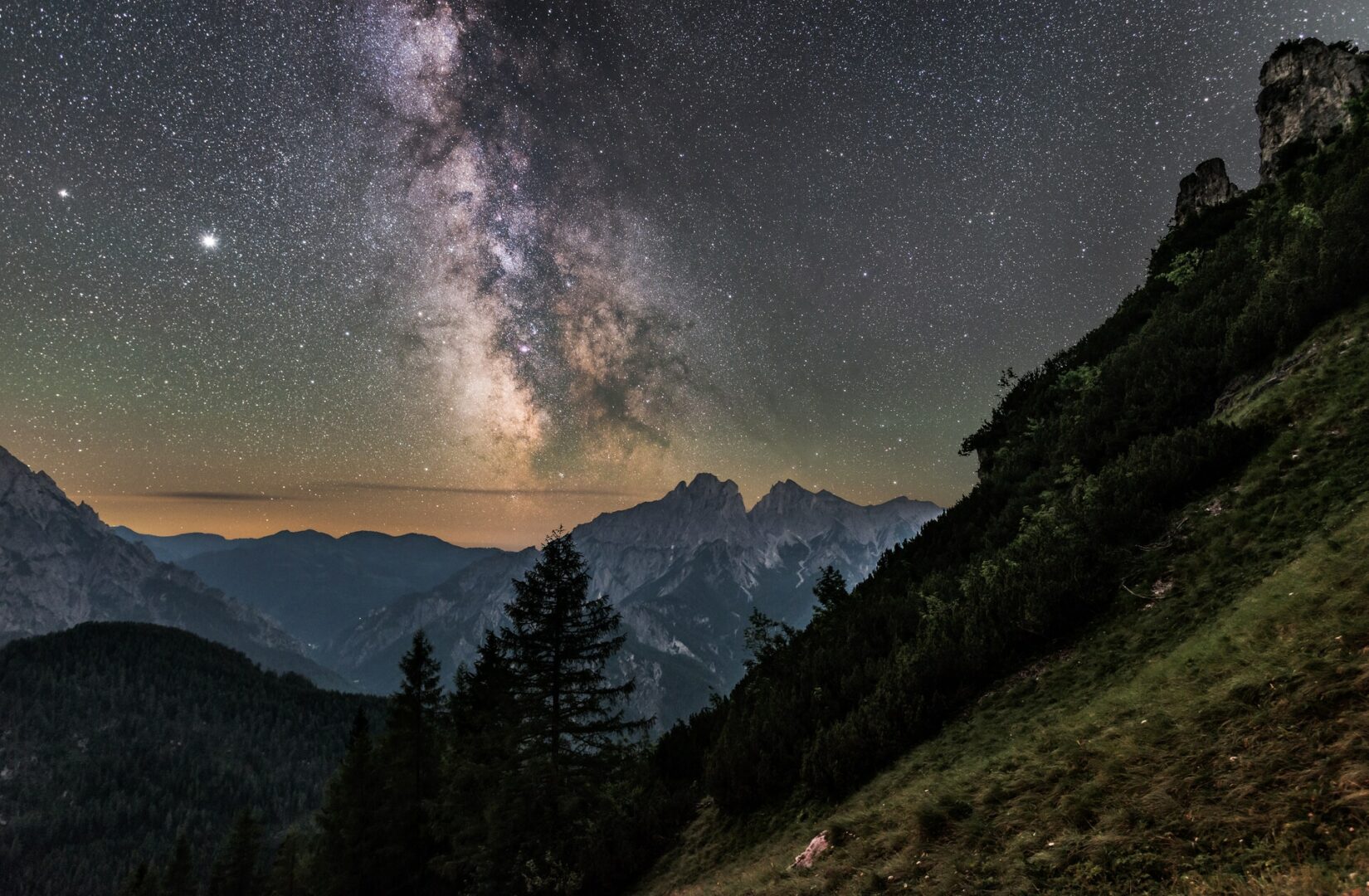
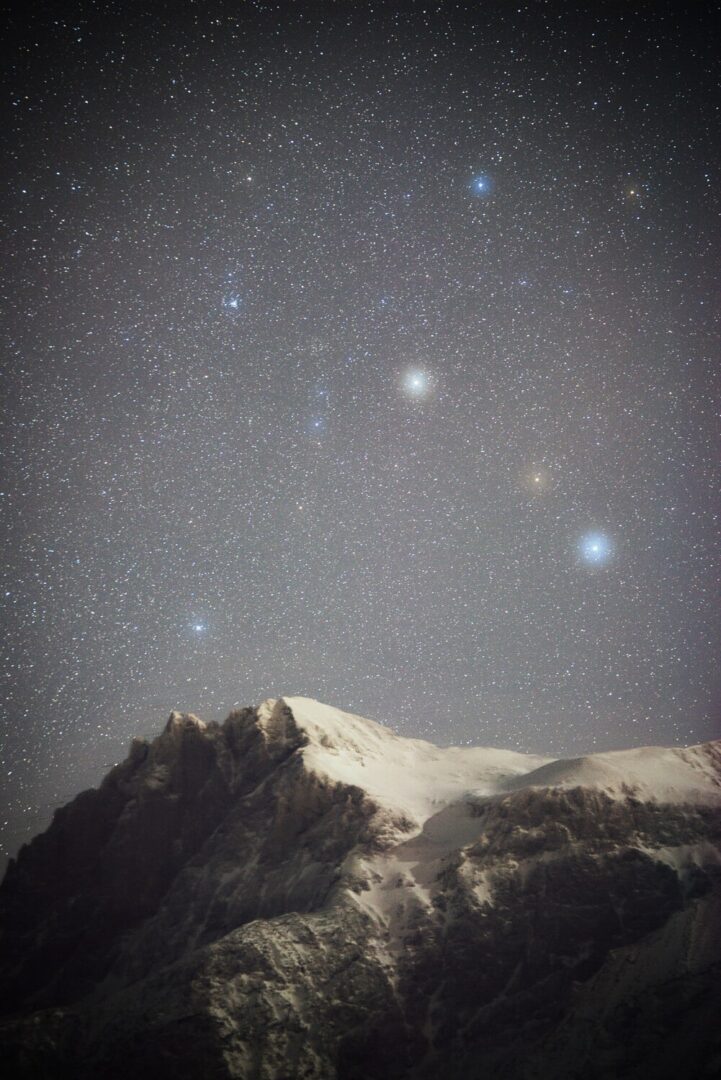
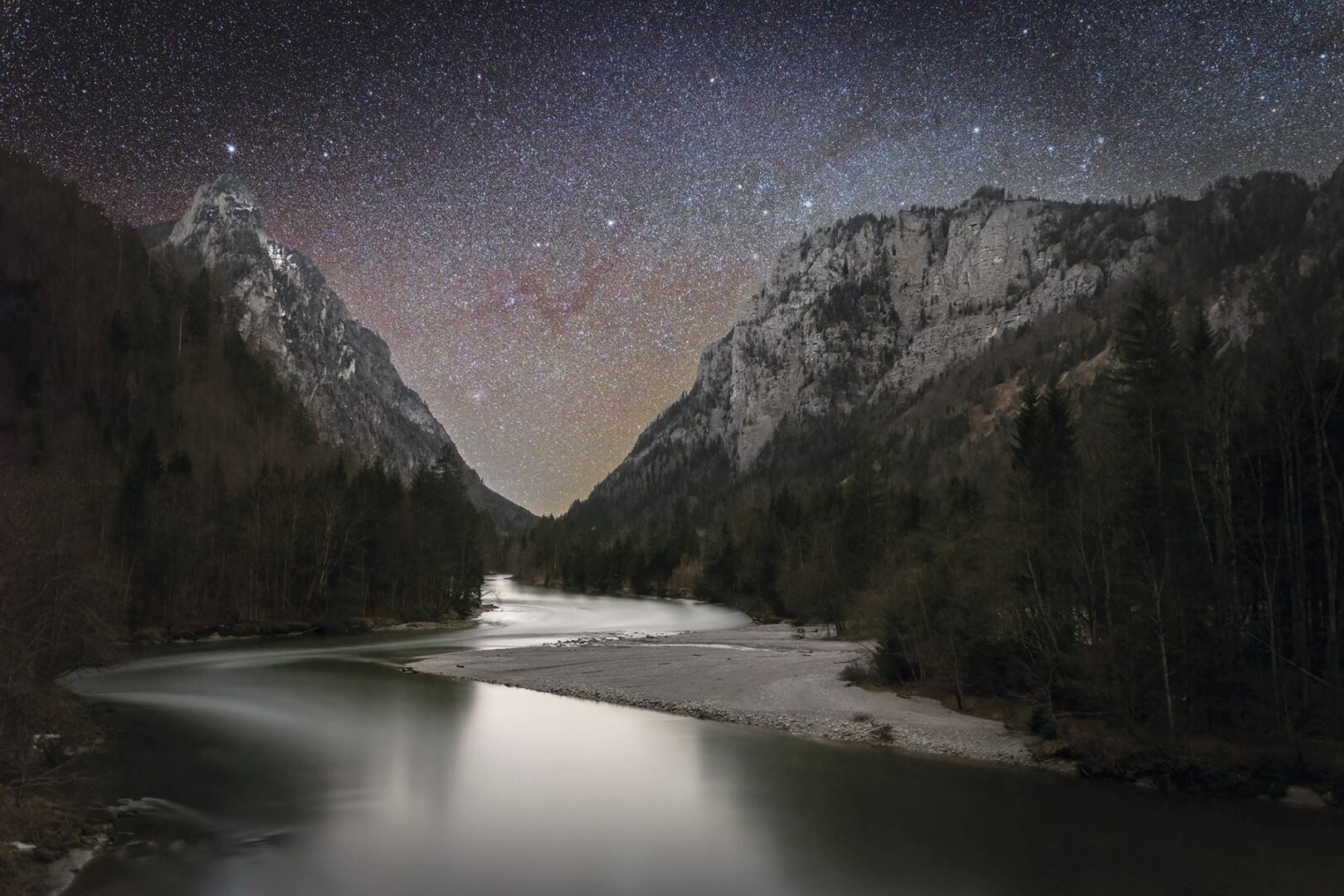
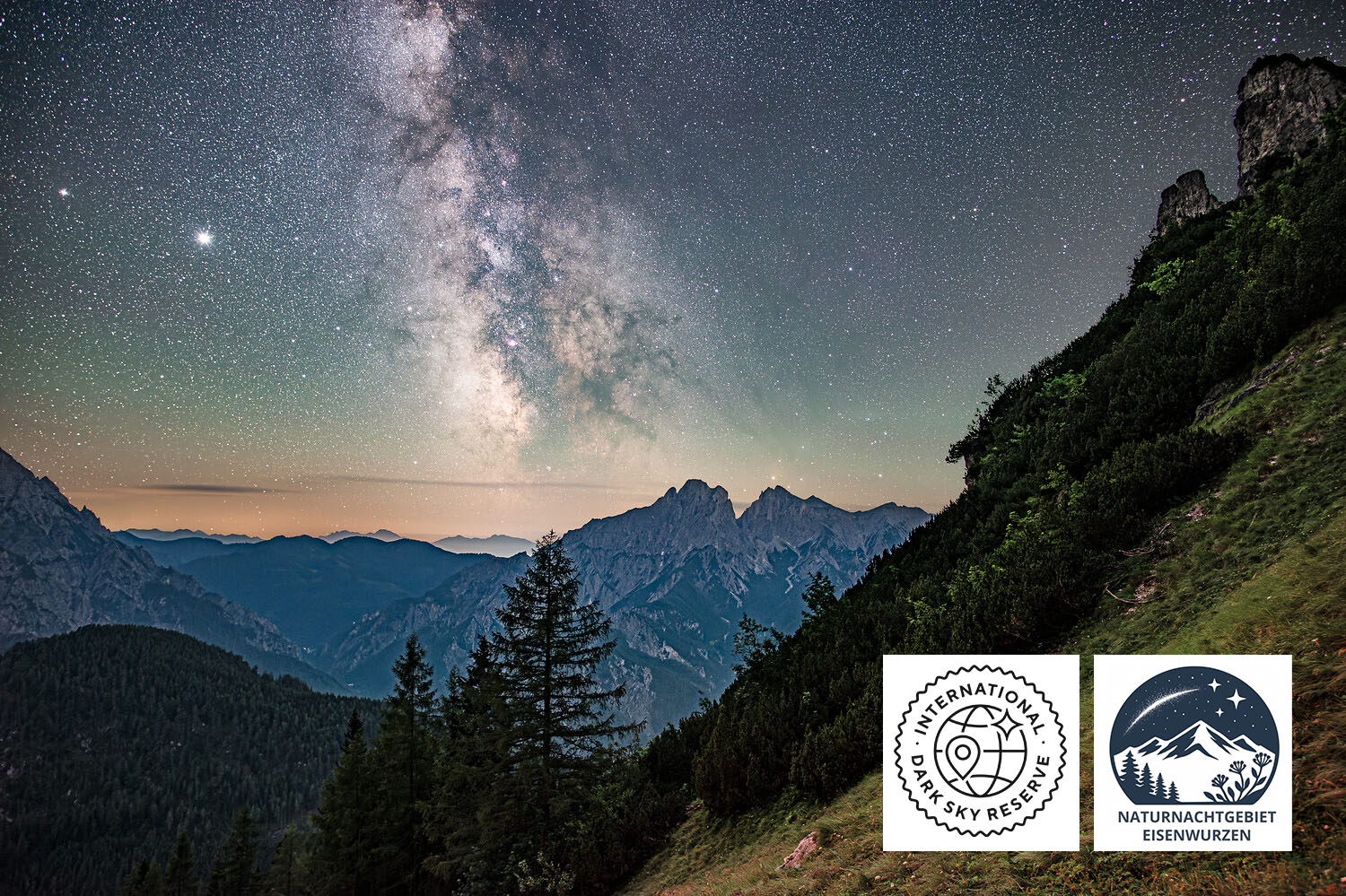
The Gesäuse owes its dark starry sky to its geographical location, because Austria's largest cities Vienna, Graz, Salzburg and Linz are quite far away from the Gesäuse. It lies, so to speak, exactly in the dark middle between these metropolises.
Admittedly, it rains more often in the Gesäuse. The average annual precipitation ranges from 1162 mm in Admont to 1584 mm in Hieflau, but when the sky is clear and cloudless, the stars shine with a clarity that can only be found in very few places in Central Europe. 6000 stars are visible to the naked eye. A look at the light pollution map illustrates the special location of the Gesäuse: www.lightpollutionmap.info.
Die Nacht ist allerdings für viele Wildtiere eine sehr sensible Zeit: Nur in der Dunkelheit können sie sich ungestört in ihrem Lebensraum bewegen. Unsere Gäste bitten wir, nachts von Touren ins Gelände abzusehen. Besonders gut erleben lässt sich der Sternenhimmel im Gesäuse rund um das National Park Centre Willow Dome in front of the impressive backdrop of the Hochtor group, in the back Johnsbachtal valley e.g. Kölblwirt oder am Buchau alpine pass (Parkplatz mit Ausgangspunkt zur Grabneralm). Das sind leicht zu erreichende Ziele, um Wildtiere nicht zu stören.
Im Süden der Bundesländer Oberösterreich und Niederösterreich sowie im Norden der Steiermark wurde am 17. März 2026 das „Naturnachtgebiet Eisenwurzen“ unter Schutz gestellt und von Dark Sky International zertifiziert. Alle Infos dazu findet man hier:
Hier finden Sie passende Veranstaltungen, bei welchen Sie mehr über die Besonderheiten des Sternenhimmels im Nationalpark Gesäuse erfahren können.
